8 min read
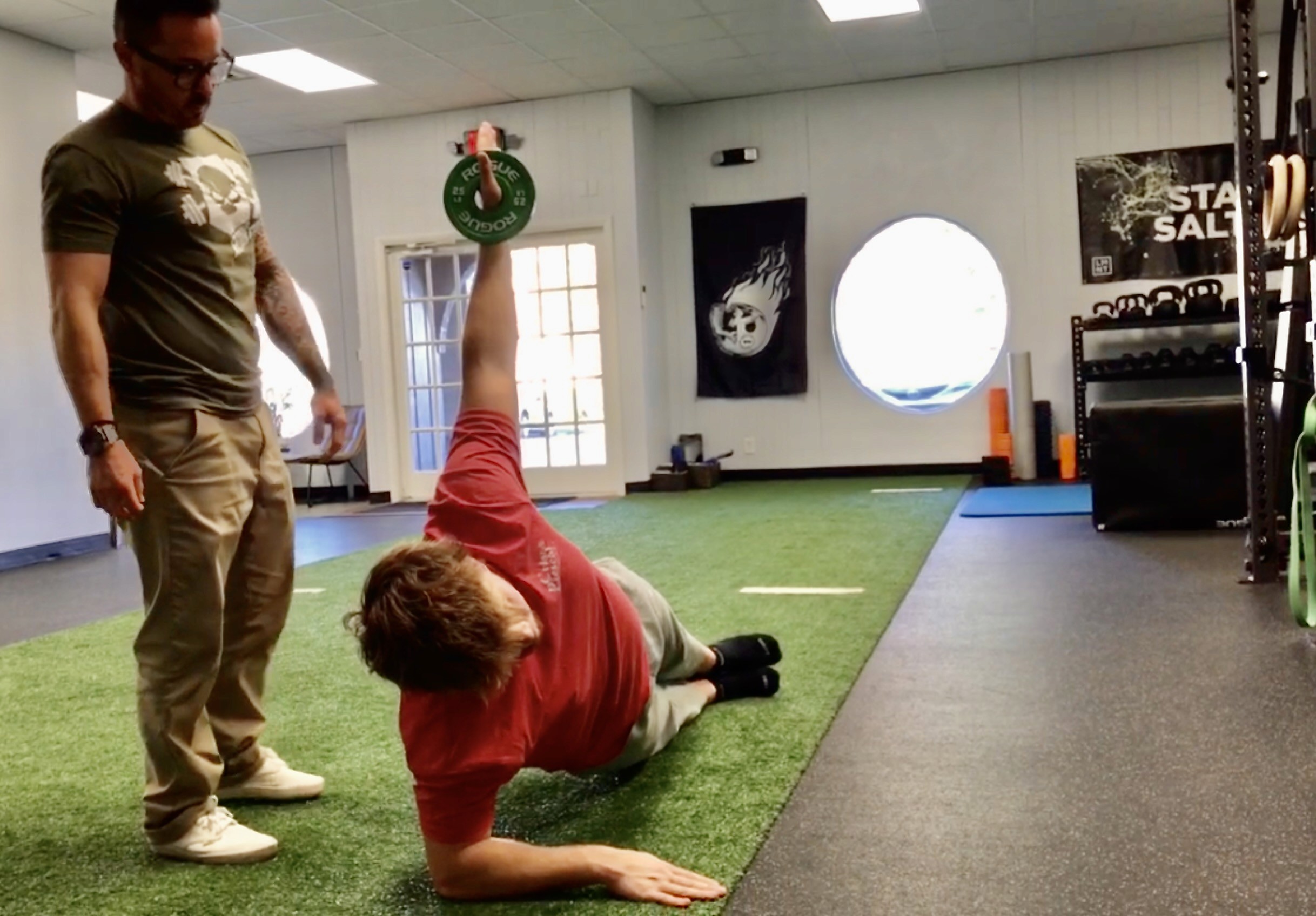
Most people think they come to us because they're in pain.
They don't.
They come to us because of what the pain took. The Saturday round of golf they keep sitting out. The grandkid they can't lift. The run that used to clear their head. By the time someone calls us, the pain is rarely the worst part — the worst part is everything the pain has quietly stolen from them.
The loss is the reason.
The pain is just the messenger.
Here's why that matters for the question you're really asking: insurance was never built to get you your life back. It's built to get you out of pain, and the moment you're out of pain, it stops paying.
But you didn't choose to read this article because you want to be a person who's merely not in pain. There's something you've been missing, and you want it back.
That's the work we do.
And it's worth being honest about who that work is for — and who it isn't.
Insurance pays for pain. It doesn't pay for your life.
Think about what an insurance company is actually paying for when it covers physical therapy. It's paying to return you to a baseline — out of pain, functional enough to get through your day. The moment you cross that line, the "medical necessity" is gone, and so is the coverage. That's not a glitch. That's the system working exactly as designed.
But "not in pain" and "back to the life you want" are two very different places. The space between them is everything you actually care about. Getting back under the barbell. Running the 5K without babying your knee. Picking up your kid without bracing for it. Returning to the sport you've been sitting out for longer than you want to admit. That space is where real physical therapy lives — and it's the exact part insurance was never built to pay for.
It's worth saying plainly what we are, because the words "physical therapy" have been stretched to cover a lot of things that aren't it.
We're not a massage.
We're not a passive modality you lie down for while a machine does the work.
We're not generic exercises run in a room full of other people while one therapist floats between six of them at once. We know what that looks like — because we treat the people who come to us after it didn't work.
Some of what gets billed as physical therapy isn't really physical therapy at all. It's a heating pad and a handout my fourteen-year-old could have given you.
We are diagnosticians. We find the root cause of your problem — whether that's a true injury or a lifestyle quietly working against you: not enough sleep, not enough fuel, no real training plan.
And we are movement experts. How you move matters, and we coach it in person, so you're not left stitching together a recovery from YouTube videos and Google searches that were never meant to replace being seen in person.
Let's talk about the money.
I never dodge the cost conversation. If anything, I lean into it, because once you understand what insurance-based PT actually costs, our model usually stops looking expensive and starts looking like the honest one.
Here's a number most people never see: outpatient, insurance-based physical therapy often runs more than $500 an hour before insurance touches it. You don't see that number, because it's buried in billing codes and "adjustments."
But you can feel it later.
Two of our clients show you how this plays out.
A woman in her fifties came to us after a hospital outpatient clinic charged her $10,000 for ten visits to treat her low back pain. Ten visits — and she was no better.
Another woman in her thirties was charged $2,400 for three visits at a hospital's pelvic floor PT clinic. Three.
These weren't scams. This is just what happens when care runs through a hospital billing system and a patient assumes insurance has it covered.
So before you assume your insurance has your PT handled, ask yourself a few questions:
Do you know your deductible — and have you actually met it?
Do you know your out-of-pocket maximum?
Do you know your family maximum?
Do you know your coinsurance percentage?
If you haven't met those thresholds, the copay you hand the front desk is just the tip of the iceberg.
The rest of the bill — the part your insurance didn't pay the clinic — will be arriving in your mailbox four to six months later, long after you stopped thinking about it. A bill you never budgeted for, for care that may not have gotten you back to the thing you wanted in the first place.
With us, there's none of that. You know the cost before you start, and the number never changes on you. (Here's exactly what we charge and why.)
So — is this right for you?
Here's where I get honest in the other direction, because not everyone needs what we do.
If your only goal is to get out of pain — nothing more — and you've got a low deductible and the patience to sit in a busy clinic, your insurance benefit might serve you just fine. I'll tell you that on the phone. I'd rather point you toward the right fit than sell you something you don't need.
But our model asks two things of you that insurance PT doesn't. And if either one is a dealbreaker, we're probably not your people.
The first: you have to actually want your life back, not just relief. The whole reason we exist is to close the gap between "not hurting" and "doing the thing you love again."
If you don't care about the second part, you're paying for a level of care you don't intend to use.
The second is the big one, and it's where the "not for you" lives: you have to be willing to participate.
We see you for one hour a week.
That leaves 167 hours where you are either reinforcing the work we did together or quietly unraveling it.
We are not in the business of laying hands on you once a week and sending you off to wait for a miracle. The patients who get the results we're known for are partners in the work — they do their part in the 167 hours. If you're looking for someone to fix you while you stay on the sidelines of your own recovery, I'll be straight with you: we're not it.
And here's what I've noticed about the people who do want to do it right — a lot of them come to us at the very start of their problem, not the end.
They don't want to spend three months in a system that isn't working and then try to catch up. They want to do it right the first time. That's our favorite kind of patient.
If that's you, you probably already know it.
The honest version
Cash-pay physical therapy isn't for everyone, and I won't pretend it is. If you want relief and nothing more, use your benefit — genuinely.
But if there's something the pain has stolen from you — a sport, the freedom to move, a connection with a loved one, a version of yourself you miss — and you want it back, that's exactly the work we do. It's the work insurance was never built to pay for.
If you're not sure which person you are, that's what the call is for.
Tell us what you're dealing with and what you're trying to get back to, and we'll tell you honestly whether we're the right fit — even if the answer is "use your insurance this time."
And if you decide we're not for you? That's your call to make.
We'll just tell you what you're missing — and be here when you're ready.
— Dr. Tim Cummings, PT, DPT Co-Founder, Restore Thrive
Frequently Asked Questions
Why don't you take insurance?
Because insurance pays to get you out of pain, then stops — and most of our clients want more than that. They want their sport, their freedom, their life back. That's the work insurance was never built to pay for. Taking insurance out of the equation lets us give you one-on-one, hour-long care aimed at the goal you actually called about, not the baseline an insurer is willing to reimburse.
Is cash-pay physical therapy worth it?
It depends on what you want. If your only goal is short-term relief and you have a low deductible, your insurance benefit may serve you fine — and I'll tell you that honestly. But if you want to get back to something the pain took from you, and you want it done right the first time, cash-pay care is usually faster, more focused, and — once you account for deductibles and surprise bills — often costs less than it appears.
How much does physical therapy cost without insurance?
At Restore Thrive, you know the price before you start, and the number never changes on you. (We lay it all out here.) Compare that to insurance-based outpatient PT, which often runs more than $500 an hour before insurance touches it — with the unpaid balance arriving as a surprise bill months later.
Do I need a referral to see a cash-pay physical therapist in Kansas?
No. Kansas is a direct-access state, so you can be evaluated and treated by a licensed physical therapist without a physician's referral. You can book with us directly.
FREE GUIDE FOR ACTIVE ADULTS 40+
When something hurts, where should you actually start?
Most active adults pick the wrong starting point — not because they aren't smart, but because no one ever explained what each option is built to do. The free guide breaks down PT, urgent care, primary care, and the ER, with a real patient case study and a side-by-side cost comparison.