8 min read
There's a moment in almost every physical therapy patient's experience that nobody warns them about.
It's the discharge appointment.
The PT tells them they're cleared. The pain is gone. They've checked the boxes — range of motion, strength, the functional tests required for sign-off. They walk out of the clinic, and the assumption — by the patient, by the insurance company, by most of the system — is that the job is done.
It isn't.
Being out of pain is not the same as being back to your sport.
Being back to your sport is not the same as being back to performance.
And the system, the way it's currently built, has almost no answer for those last two steps.
The gap nobody talks about
I've spent more than 25 years as an athletic trainer. I've worked with athletes across every level of sport — high school, college, MLB, NFL, NBA — and the same pattern shows up regardless of the level. An athlete gets hurt. They do all the rehab. They get cleared. Then they come back to their sport, tentative, undertrained, and at higher risk for the next injury.
Sometimes the next injury is the same one. Sometimes it's a new one, somewhere else, because the body compensated for months, and nobody addressed the compensation.
Sometimes there isn't a re-injury —it's worse, the athlete has a permanent drop in performance, and they never quite get back to their previous level of performance. They make the team, they finish the season, they tell themselves they're fine.
They're not fine. They're operating below what they were.
The reason this happens isn't because PTs are doing a bad job. It's because PT, by design, ends at the wrong place.
Physical therapy is built to restore function. That's its job. It is excellent at getting a patient out of pain and back to the baseline activities of daily life.
But the gap between daily-life baseline and back-to-your-sport-at-full-performance is enormous, and it's almost never bridged inside the conventional model.
Insurance won't pay for it. Most clinics aren't built to deliver it. And the patient ends up on their own — usually with a printed exercise sheet and the suggestion that they "ease back in."
That's the gap Athletic Training Plus exists to bridge.
The methodology that changed how I think about this
Almost 11 years ago, I was exposed to the Power Athlete methodology — the strength and conditioning system Dr. Tim Cummings and I have both worked with as coaches and consultants.
The thing that hit me wasn't a single exercise or a specific technique. It was the principles.
The same principles that get a professional athlete back to elite performance — foundational movement, progressive overload through full ranges of motion, intelligent load management, the development of central nervous system capacity alongside raw strength — those same principles work for everyone.
A 17-year-old high school catcher coming back from a knee injury.
A 45-year-old recreational lifter trying to return to the weight room.
A 60-year-old who just had a shoulder repaired and wants to swing a golf club again without thinking about it.
The methodology doesn't change. The load changes, the progression changes, the timeline changes — but the underlying principles are the same.
That was the realization. The athletes I'd been working with at the high school level didn't need a different system than the pros. They needed the same system, scaled appropriately, applied with the same care.
When Tim and I built Athletic Training Plus into the Restore Thrive model, that's the principle we built it on. We treat the return-to-sport phase the same way we'd treat a professional athlete's offseason program — because if the principles are right, the principles are right.
What Athletic Training Plus actually does
Athletic Training Plus is what happens after a patient has gotten out of pain and is ready to get back to performing.
A typical AT+ relationship starts the same way most things at Restore Thrive start — with a thorough evaluation. We look at the athlete in front of us and we identify what we call developmental gaps: the places where their movement, strength, or capacity isn't where it needs to be for the demands they're about to put on it.
For a post-PT patient, those gaps are usually a combination of two things. First, the residual deficits from the injury itself — the side that's still slightly weaker, the range of motion that hasn't fully come back, the compensation pattern the body developed during recovery.
Second, the deficits that were already there before the injury and probably contributed to it. Most injuries aren't bad luck. They're the consequence of a movement pattern or a capacity gap that finally broke down under load.
From there we build the program. Not a printed sheet. Not a recycled template. A specific, progressive plan built around that athlete's gaps, that athlete's sport, and that athlete's timeline.
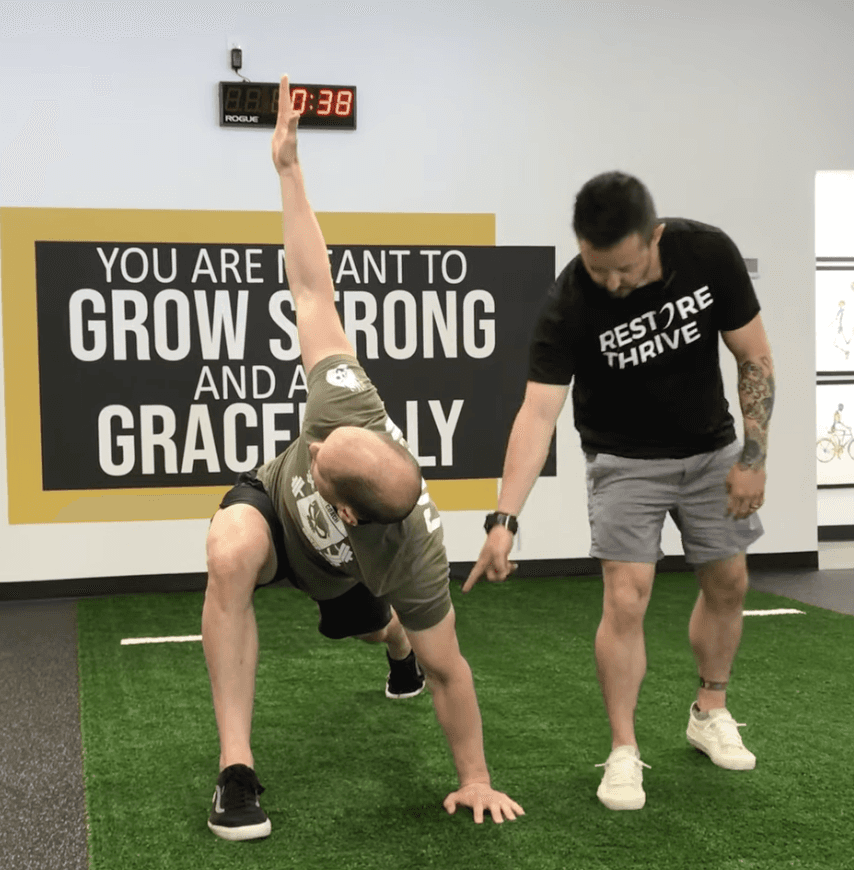
The work itself looks like coaching, not like rehab. We're coaching the eight primal movement patterns — squat, hinge, lunge, step-up, horizontal push, horizontal pull, vertical push, vertical pull — through full ranges of motion, with attention to setup and execution.
We're loading those patterns progressively. We're developing speed and change-of-direction capacity in athletes whose sport demands it. We're integrating sport-specific work as the foundation gets strong enough to hold it.
The sessions are 60 minutes. One-on-one. Same coach every visit. No handing off to aides. No splitting attention between three athletes in the room.
That sounds like a small thing. It isn't.
The reason most return-to-sport programs fail isn't that the exercises were wrong. It's that nobody had the time to coach the setup, observe the execution, and adjust the load in real time.
Without that, you're just hoping the athlete is doing it correctly between visits. They almost never are.
Who this is for
The thing I love about Athletic Training Plus is the range of athletes it serves.
I work with teenagers who are returning from their first significant injury and need to come back stronger than they were before.
I work with high school and college athletes preparing for the next level — the ones who haven't been hurt but who know that foundational athletic development is what separates the ones who make it from the ones who plateau.
I work with adults over 60 who are new to real strength training and want to do it the right way, with someone watching their setup and protecting their joints.
I've coached competitive and amateur CrossFitters. I've worked with high school and college athletes across nearly every sport. I've consulted with professional athletes in MLB, NFL, and NBA. The principles scale. A 17-year-old's hinge pattern and a 58-year-old's hinge pattern have more in common than people think — both need to be coached well, loaded appropriately, and progressed with intention.
One athlete I've worked with for a long time is Aiden, Dr. Tim's son. I started coaching him when he was just beginning his journey in athletics, and we've stayed at it ever since. The foundation we built — daily warm-ups, primal movement patterns coached with attention to detail, progressive overload through full ranges of motion, sprinting, and change-of-direction work — is the same foundation I'd build for a college recruit or a returning professional athlete. The load is different. The principles are the same.
A few months ago I spoke with a former athlete of mine who'd signed an MLB contract to play catcher for the St. Louis Cardinals. He'd come back from two potentially career-ending knee injuries, played two major-conference college seasons while earning two degrees, and made it to the majors. We talked about what had actually gotten him there. His answer was simple: the foundation we built when he was young held every time he had to come back from a setback.
Every time.
That's what Athletic Training Plus is doing — building the foundation that lets an athlete withstand whatever comes next.
What Athletic Training Plus is not
This is the part of the conversation that matters most, because the keyword "performance training" gets used so loosely that most people don't know what it actually means.
AT+ is not extended physical therapy. PT is restorative care. It addresses pain, restores function, and returns a patient to baseline. By the time a patient is referred to AT+, they've already done that work — either at Restore Thrive or somewhere else. AT+ picks up where PT leaves off.
AT+ is not personal training. I have respect for good personal trainers, but personal training and athletic training are different professions with different scopes. A licensed athletic trainer brings a clinical background — injury history, return-to-sport protocols, the ability to communicate with PTs and physicians, the training to recognize when something isn't right, and route it appropriately. We bridge the gap because we have feet in both worlds.
AT+ is not sport-specific skill work. A baseball player needs a hitting coach. A golfer needs a swing coach. A lifter needs to spend time on competition lifts. AT+ isn't trying to replace any of those. What AT+ does is build the underlying athletic foundation — the strength, the movement quality, the central nervous system capacity — that lets all of that skill work translate into actual performance.
The simplest way I can put it: AT+ is what happens when you take the principles that get pro athletes back to elite performance, and you scale them down — with the same care — for the athlete who's standing in front of you. Whoever that athlete is.
How it fits at Restore Thrive
The reason this works at Restore Thrive specifically, and the reason it's harder to do anywhere else, is that the model lets us actually deliver it.
We're not a high-volume clinic. We don't have to see 30 patients a day to keep the lights on.
That means I can spend a full 60 minutes with the athlete in front of me, watch their setup, correct their execution, and adjust the load in real time. It also means I can talk to Dr. Tim or Dr. Jess about what they're seeing on the PT side, and we can coordinate the handoff from PT to AT+ without the patient feeling like they're starting over with a stranger.
It also means we can pick up an athlete years after their initial care.
Dr. Tim has a line he uses with patients that captures the operating principle better than anything I could write: "You do not have an expiration date." What he means is that the work doesn't end at discharge. The relationship doesn't end at discharge. As your goals shift, as new challenges appear, as you keep moving and lifting and competing — we're still here.
I have a motto I've used for more than 20 years: once my athlete, always my athlete. It started in the high school setting, with the kids I worked with. They knew that years later, if they needed help with an injury, advice on a training goal, or just a sounding board, they could reach back out and I'd be there.
That motto applies just as much now, at Restore Thrive, as it did then. Athletic Training Plus isn't a 10-visit punch card. It's an ongoing relationship — one that's there when you need it and respectfully out of your way when you don't.
If this sounds like where you are
If you've finished a course of PT and you're not all the way back, AT+ is probably what you're missing.
If you're an athlete preparing for a competitive season and you want a coach who can build the foundation — not just hand you exercises — AT+ is what you're looking for.
If you're over 40 and you want to lift, move, and perform with someone who has the clinical background to keep you safe and the coaching background to actually make you stronger, AT+ is built for you.
The simplest first step is a free 15-minute phone consultation. We'll talk through what you're trying to get back to, what you've already tried, and whether Athletic Training Plus is the right fit.
If it's not, we'll tell you what is.
Book a free 15-minute consultation →
Once my athlete, always my athlete.
— Dennis Dolan, MS, ATC, Director of Athletic Training, Restore Thrive
FREE GUIDE FOR ACTIVE ADULTS 40+
When something hurts, where should you actually start?
Most active adults pick the wrong starting point — not because they aren't smart, but because no one ever explained what each option is built to do. The free guide breaks down PT, urgent care, primary care, and the ER, with a real patient case study and a side-by-side cost comparison.